

Different ways of talking about the future
One very good way to prepare for your IELTS speaking is to practise different ways of talking about the future. This is because the examiner listens for the way you vary your grammar, not just if you make mistakes.
This is a skill you need mostly in part 1 and 3 parts of the Speaking test.
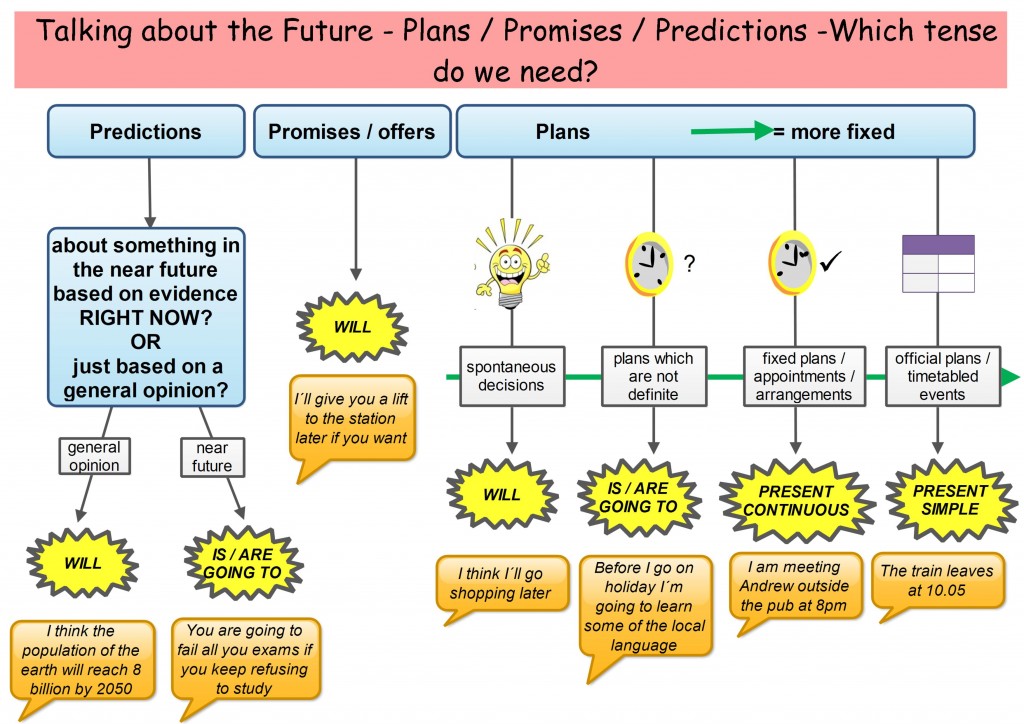
In fact, there are loads of more ways of talking about the future. It’s not all about verbs and tenses, see these examples:
1)We often use verbs like ”would like”, “plan”, “want”, “mean”, “hope”, “expect” to talk about the future:
What are you going to do next year? I’d like to go to University.
We plan to go to France for our holidays.
George wants to buy a new car.
2) We use modals: “may”, “might”, and “could” when we are not sure about the future:
I might stay at home tonight, or I might go to the cinema.
We could see Mary at the meeting. She sometimes goes.
6. We can use “should” if we think something is likely to happen:
We should be home in time for tea.
The game should be over by eight o’clock.
7. Clauses with time words:
In clauses with time words like when, after, and until we often use a present tense form to talk about the future:
I’ll come home when I finish work.
You must wait here until your father comes.
They are coming after they have had dinner.
8. Clauses with if:
In clauses with if we often use a present tense form to talk about the future:
We won’t be able to go out if it rains.
If Barcelona win tomorrow they will be champions.
I’ll come home when I will finish work.
We won’t be able to go out if it will rain rains.
 English (UK)
 Български
 简体中文
简体中文 Čeština
 Dansk
Dansk Nederlands
 Eesti
Eesti Suomi
Suomi Français
 Deutsch
 Ελληνικά
 Magyar
 Bahasa Indonesia
 Italiano
 日本語
日本語 한국어
한국어 Latviešu valoda
 Lietuvių kalba
 Norsk bokmål
 Polski
 Português
 Română
 Русский
 Slovenčina
 Slovenščina
 Español
 Svenska
 Türkçe
 Українська
Inga kommentarer